I Lift My Hands in Total Praise

How the Sounds of Gospel Music Shaped Our Engagement with God Emotionally, Spiritually, and Communally

A Soundtrack for the Soul

In every season of life, mountaintop joy, valley sorrow, long nights of uncertainty, and eruptions of praise, Gospel music has been our companion, our language of faith, and our sacred memory. For many of us raised in Black church traditions, Gospel is not merely a genre; it is formation. It taught us how to feel God, how to speak to God, and how to remain connected to one another when words alone failed.

● Gospel music gave us language when silence threatened to swallow us.
● It gave us prayers when grief stole our breath.
● It gave us community when isolation pressed in.

And now, with the passing of one of Gospel music’s most gifted lyricists, composers, musicians, and prophetic voices, Richard Smallwood, we find ourselves returning again to the sounds that carried us through every imaginable life experience. His passing is not only an ending; it is a summons: to remember, to reground, and to sing again.

A Life Steeped in Sound and Scripture

Richard Smallwood’s life unfolded at the intersection of classical excellence, Black sacred tradition, and deep personal faith. Trained formally in music, yet profoundly shaped by the Black church, his compositions blended theological depth with musical sophistication. He did not dilute Gospel to make it palatable; he dignified it by honoring both its intellect and its soul.
From choir lofts to concert halls, from church basements to college auditoriums, his music bore intention. Every lyric was steeped in Scripture. Every harmony carried memory. Every pause invited reverence. Yet his genius was not only technical, but it was also pastoral. His songs understood human vulnerability. They made room for sorrow and doubt without forfeiting hope.

“Deep calls to deep at the roar of your waterfalls.” Psalm 42:7
His music sounded like that depth calling out: soul to God, generation to generation.

Sound as Sacred Language: How Gospel Shaped Our Engagement with God

Emotionally

Gospel music taught us that emotion is not the enemy of faith. Tears were not weakness but honesty. When we sang “Center of My Joy,” many of us were standing in grief, holding loss that had no name. When “Lead Me, Lord” (1979) filled sanctuaries and living rooms, it became a cry for guidance when the road ahead felt unbearable.
When “There Is a Balm in Gilead” emerged through Smallwood’s arrangements, it was not theoretical healing we encountered; it was embodied hope. We heard restoration before we felt it. We trusted healing because the sound carried it. Songs like “I Give You Praise” taught us how to worship without conditions, praise offered not because everything was resolved, but because God was still worthy. These songs gave us permission to feel with God, not just believe about God.

Spiritually

Gospel music discipled us. We learned Scripture by singing it. We learned trust by repeating it. “Total Praise,”born out of personal sorrow, echoed Psalm 121, “My help comes from the Lord,” embedding Scripture into our spiritual muscle memory. We did not merely sing theology; we inhabited it.

Communally

Gospel music gathered us. Choir rehearsals doubled as healing circles. All-night sing-alongs stitched together shared stories of survival and celebration. Funerals, baptisms, graduations, revivals, Gospel was present at every communal threshold. In the Black experience, especially, Gospel became the sound of collective endurance. It carried the weight of history, resistance, and hope. It reminded us that even when systems failed us, God had not.

When Sound Becomes Flesh: Listening as Spiritual Awakening

There are moments when listening to Richard Smallwood’s music is no longer a passive experience; it becomes participatory, even visceral.
● You may have found yourself crying without warning.
● Pensive, staring at nothing yet feeling everything.
● Humming before realizing you knew every word.
● Shouting as the harmony resolved something deep within you.
● Or wearing the unmistakable “stank face,” that holy expression of awe when genius meets anointing.

Smallwood’s compositions did not merely reach the ears; they traveled through every cell of the body, through breath, muscle, memory, and spirit, elevating us bar by bar into something that felt like a spiritual reawakening. This was not accidental brilliance. He was led by God and honored God’s gift, using it fully in life and leaving it faithfully as legacy.

Listening as Devotion: Studying the Sound

Smallwood’s performances teach us how to listen.
The pauses remind us to be still.
The gradual build teaches patience and order.
The harmonic shift carries emotional weight.
The ending offers rest, not frenzy.
“Be still, and know that I am God.” (Psalm 46:10)
Listening becomes prayer. Sound becomes sanctuary.

The Humanity Behind the Mantle: We Only Sang What He Sang First

Sometimes we forget that individuals so greatly gifted, carrying a heavy mantle as vessels for God, are human also. The fragility of life is evident in the aging process, illness, exhaustion, and trials that test the soul. Richard Smallwood was not exempt from this reality.

Often, his lyrics told his story before interviews ever could. In this way, Richard Smallwood stands among the ancient tradition of the psalmists, a modern-day psalmist offering the world his innermost conversations and experiences with God. Like David, he prayed aloud through music. He lamented. He trusted. He waited. He praised.
“I pour out my complaint before him; I tell my trouble before him.” Psalm 142:2

The truth is, we only sang what he sang first.

What became communal worship began as personal prayer. What became an anthem was first a whisper. Through his music, he mentored us in how to park our situations in praise, not as denial, but as surrender. He gave us permission to feel every emotion while remaining rooted in faith.

His songs became a welcome place created by the Holy Spirit, a sacred space where transparency with God was not only allowed but encouraged. We learned that worship does not require emotional restraint. We learned that reverence and rawness can coexist. We learned that praise is not escapism; it is engagement.

“Trust in him at all times… pour out your hearts before him.” (Psalm 62:8)

Smallwood’s humanity mattered because it made the music believable. His vulnerability mattered because it made worship accessible. His faith was not curated, it was lived.

Songs That Held Us: Personal and Communal Testimony

Some songs do not simply accompany life; they hold it.
● “Center of My Joy” held me through deep grief and loss.
● “My Everything” reminded me that Jesus was my center.
● “There Is a Balm in Gilead” assured us healing would come.
● “I Give You Praise” taught us how to worship while the story was still unfolding.

These songs did not rush restoration. They stayed with us inside the process. They all led us to the Word:
“Weeping may endure for a night, but joy comes in the morning” (Psalm 30:5).
Gospel music taught us how to live faithfully in the night.

Total Praise: His Story, His Song, and His Soul

One of the most profound mirrors into Richard Smallwood’s life and inner world is his 2019 autobiography, Total Praise, a title drawn from one of the very songs that became a staple of global worship and comfort. In an interview about the book, Smallwood shared that he originally intended to write about music and the industry, answering questions like “Where did these songs come from?” but the project quickly became far more personal than he expected. His manager encouraged him to share something Smallwood had never publicly discussed, his struggle with depression. At first, he resisted, fearing judgment. But he came to realize that honesty about his struggle could help others in theirs.

This candor reveals what we’ve always sensed under the surface of his music: the songs are not merely artistic compositions, but chronicles of lived encounter; intimate spiritual dialogue framed by very real human pain, questioning, longing, and transformation. Through Total Praise, he showed us that behind the soaring harmonies and glorious proclamations were a life tested and refined, not untouched by trouble but strengthened through it.

In the book, Smallwood also traced his family history, going back generations to better understand the roots that shaped his soul and sound. His mother’s presence, creative encourager, early teacher, and communal anchor, is woven throughout the narrative. Smallwood credited her not only with nurturing his musical gifts but with shaping the culture of heart and home that equipped him to minister through music. Perhaps most revealing is how Total Praise underscored that this music was never merely entertainment:

● It was born in trial and caregiving, particularly the time Smallwood spent caring for his mother and a terminally ill friend, both of whom inspired “Total Praise.”
● It was formed in the personal wrestle with sorrow, music that didn’t ignore hurt but entered it before offering praise.
● And it emerged not from perfection but from persistent faith, the choice to lift eyes and voice even when exhaustion and burden threatened to overwhelm the spirit.
Smallwood’s own journey, documented in Total Praise, invites us to see his songs not just as beautiful melodies, but as living prayers shaped by confrontation with life’s hardest moments. They are Psalms for our time: authentic, honest, and anchored in God. In his autobiography, Smallwood unwittingly coached us in the very posture of faith that he taught through music, that worship is not absence of pain, but triune engagement with God through it.

A Chorus of Witness: Tributes That Cross Every Boundary

In the days following his passing, tributes poured in from Gospel and Christian communities, secular artists, classical musicians, college choirs, bands, pastors, and listeners worldwide. God expanded his reach across cultures, languages, creeds, denominations, economic boundaries, and every stage of relationship with God, drawing all closer through a musical narrative of an invitational God who loves, cares, protects, and provides.

Richard Smallwood may be sleeping for now, but his work is alive and well. Alive in sanctuaries and concert halls. Alive in rehearsal rooms and home playlists.  Alive in trembling voices and quiet tears.
“Blessed are the dead who die in the Lord… for their works follow them.” Revelation 14:13

We Sing On

Richard Smallwood gave us more than music. He gave us language for pain, structure for praise, and permission to bring our whole selves before God.
So we sing on.
With tears.
With harmony.
With honesty.
“Let everything that has breath praise the Lord” (Psalm 150:6)
And so we do!

Richard Smallwood Discusses his Autobiography, “Total Praise” – Journal of Gospel Music
Deep Roots Magazine
Total Praise The Autobiography Richard Smallwood
Richard Smallwood, a soaring voice in gospel music, dies at 77 – The Washington Post


Gospel Music Icon Richard Smallwood Remembered

Editor’s Note: Richard Smallwood, (1948-2025) is being remembered by musicians and mourners alike Saturday at the First Baptist Church of Glenarden, International in Upper Marlboro, Maryland. Smallwood’s classically influenced gospel standards such as “Center of My Joy,” “I Love the Lord” and “Healing,” live on in the repertoire of the Black church. His closely personal, spiritual anthem “Total Praise” is just one of more than 125 recorded songs from more than 16 albums.  Grammy nominations, Dove and Stellar Awards, recognized his glorious and soaring scores, but this intensely intimate praise will continue to inspire and transform in the hands of those he mentored.

Jason Max Ferdinand, Conductor

I count myself profoundly blessed to have served on the musical staff of Metropolitan Baptist Church, then located at 12th and R Streets in the nation’s capital. The Rev. Dr. H. Beecher Hicks Jr.—one of the most celebrated preachers of our time—was our pastor, and the incomparable Rev. Nolan Williams served as Minister of Music. My years there were an extraordinary school of learning in music ministry, a season of growth and refinement that was truly unparalleled.

Each December, Metropolitan would present the gospel version of Handel’s Messiah, followed the very next week by the original Messiah. Distinguished conductors from across the country—and from around the world—were invited to lead these sacred offerings. In 2006, Nolan entrusted me with the honor of conducting the presentation. A few days later, I received a message that I will cherish forever:

“Young man, I was not able to be there in person, but I want you to know that I saw the recording. I thoroughly enjoyed the presentation, and you, my friend, are a conductor for real.”

Those words came from Richard Smallwood.

Richard soon became a dear mentor and friend. He was witty, deeply inspiring, and utterly genuine—you always felt his heart. He spoke candidly about life’s challenges, about the long and often difficult road of gospel music finding acceptance in academic spaces, and he never failed to encourage the next generation. As a young musician, I studied his compositions and marveled at his piano solos on recordings. What many may not realize is that this was how he played during worship—every single time. When Richard arrived for service, the rest of us on staff would smile and say, “Alright everyone, class is in session.”

Richard was a master of service music. One need only visit YouTube to witness how, with nothing more than his hands on the keys, he could shift the entire atmosphere of a worship service. It was nothing short of miraculous—holy, even. To experience it in person was surreal.

The photo here was taken at Takoma Park Seventh-day Adventist Church. The Aeolians were on tour, and I had mentioned the program to him. Given hisThe author Jason Max Ferdinand standing with the late musician Richard Smallwood. demanding schedule, I truly did not expect him to attend. He said he would try, as he was between trips. And yet, when I walked out to begin the program, there he was—front and center. Richard also came to Oakwood to be part of the Aeolian Alumni Weekend concert during my time there, another gift I will forever treasure.
I will miss him more than words can fully express. My heart had already begun to ache when he could no longer respond to texts or calls. Even knowing this day was coming did not make it any easier. The loss still feels heavy, still feels unreal.

Dear Rich—as I always called him—I am clearing my schedule so that I can honor you properly, front and center, just as you so often showed up for me. “’Twill be sweet when we meet over on the other side.”
With tears and with gratitude,
Your mentee,
Jason Max Ferdinand


Anika Anderson, Soprano

I remember hearing Richard Smallwood’s music as a little girl at the home of our family friends on a Sabbath afternoon. It was such a new sound it stuck with me.

Over the years I have had the opportunity to have many encounters with Richard Smallwood and his singers. In elementary school I sang in a group called Promises and we were invited to sing on a program honoring him at Bibleway [Church]. He and his mother were present.

My parents sang back up on a local cable show hosted by Wintley Phipps called Heartsongs and [Smallwood] was a special guest artist, and I was able to

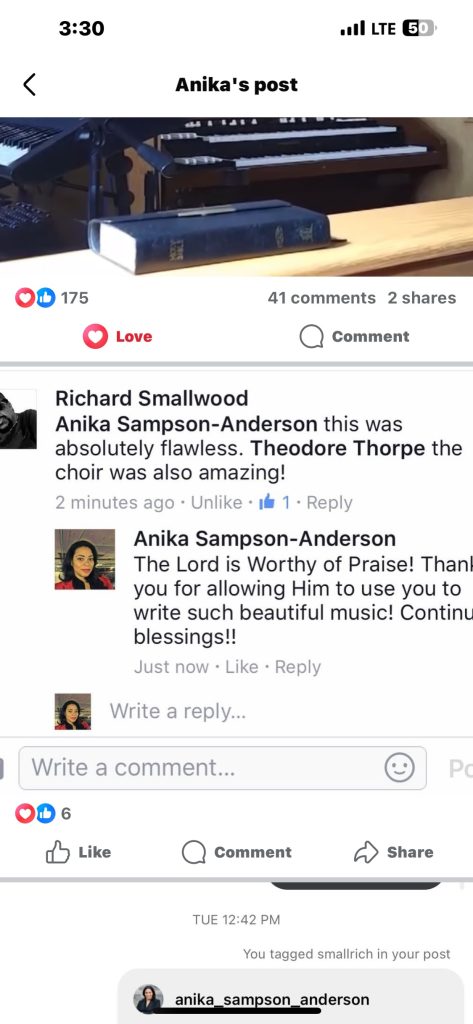
Screenshot

meet him as a pre-teen. I sang under his direction as an Oakwood Aeolian (and yes, they let us have drums for that concert at the church back then), I was asked by Darin Atwater to sing the solo to “We Worship You” with Soulful Symphony at the Meyerhoff in Baltimore, originally recorded by one of my greatest soprano influences, Janice Chandler Etème, on “The Journey”Live in New York” album and that invitation which led to many more.

Richard Smallwood was always gracious and encouraging. His musical influence has touched so many and I’m grateful to have the privilege of being in such close proximity so many times.


Richard Smallwood, ‘Total Praise’ Composer, Receives Juneteeth Tribute in D.C.

For decades, Richard Smallwood has been on stages from Carnegie Hall to churches, at the piano or at the microphone, performing music that features his distinctive genre-bending blend of gospel and classical.

Now, as a way to mark both his 75th birthday and Juneteenth, Smallwood is getting the Kennedy Center treatment: The Grammy nominee and Stellar and Dove awardee will get a special seat in the premiere concert hall in the nation’s capital as other gospel luminaries such as Dorinda Clark-Cole and Marvin Winans join choir members to perform in his honor.

Smallwood, who celebrated his birthday in November, launched the Richard Smallwood Singers in 1977 and then, in the 1990s, created and began touring with the ensemble Vision, which will be part of the performances on Tuesday (June 18) and Wednesday, the Juneteenth holiday that marks the effective end of slavery in America.

Smallwood is known for such hits as “I Love the Lord,” which was later recorded by Whitney Houston, and “The Center of My Joy,” which he co-wrote with Bill and Gloria Gaither.

Though Smallwood describes himself as “semiretired” and said he’s now more of a baritone than a tenor — “The notes I can hit at 28 and 27, I can’t hit anymore” — he is as devoted to supporting all kinds of music as he was decades ago when he said, “I have no problem with crossover music, as long as you carry the cross over with you.”

In an interview days before the Kennedy Center events, he said: “I think any music that preaches Jesus and him crucified is a kind of music that is appropriate in the church setting.”

Smallwood, who was raised by a stepfather who was a Baptist pastor, talked with Religion News service about his enduring music, post-COVID choir music and influences on his songwriting.


The interview was edited for length and clarity.

For decades, Richard Smallwood has been on stages from Carnegie Hall to churches, at the piano or at the microphone, performing music that features his distinctive genre-bending blend of gospel and classical.

Now, as a way to mark both his 75th birthday and Juneteenth, Smallwood is getting the Kennedy Center treatment: The Grammy nominee and Stellar and Dove awardee will get a special seat in the premiere concert hall in the nation’s capital as other gospel luminaries such as Dorinda Clark-Cole and Marvin Winans join choir members to perform in his honor.

Smallwood, who celebrated his birthday in November, launched the Richard Smallwood Singers in 1977 and then, in the 1990s, created and began touring with the ensemble Vision, which will be part of the performances on Tuesday (June 18) and Wednesday, the Juneteenth holiday that marks the effective end of slavery in America.

Smallwood is known for such hits as “I Love the Lord,” which was later recorded by Whitney Houston, and “The Center of My Joy,” which he co-wrote with Bill and Gloria Gaither.

Though Smallwood describes himself as “semiretired” and said he’s now more of a baritone than a tenor — “The notes I can hit at 28 and 27, I can’t hit anymore” — he is as devoted to supporting all kinds of music as he was decades ago when he said, “I have no problem with crossover music, as long as you carry the cross over with you.”

In an interview days before the Kennedy Center events, he said: “I think any music that preaches Jesus and him crucified is a kind of music that is appropriate in the church setting.”

Smallwood, who was raised by a stepfather who was a Baptist pastor, talked with Religion News service about his enduring music, post-COVID choir music and influences on his songwriting.


RELATED: In ‘Gospel’ docuseries, Henry Louis Gates Jr. explores Black church’s music, ministers


The interview was edited for length and clarity.

Richard Smallwood. (Courtesy photo)

Richard Smallwood. (Courtesy photo)

What does it mean to you to be able to mark this milestone in your life with a celebration of Juneteenth at the Kennedy Center?

First of all, the date of the celebration means a lot to me personally. I was thinking earlier that when I was a little boy my mother used to take me to hear the National Symphony Orchestra. Never would I think one day, they’d be playing my music. That’s amazing. And I’m so grateful.

Does Juneteenth have a personal meaning for you?

Yes, it is, because it’s for our culture. It’s a huge landmark, which signifies freedom, and so to be a part of that is a great honor and such a great opportunity.

Your music has been sung at funerals of victims of police and school shootings, accompanied liturgical dancers at church services and greeted the pope at the White House. Have you been surprised by the range of your work?

I’m always surprised. When you write a particular piece, you have no idea what’s going to become of it — will people like it, or will people sing it. And so to see the years of people embracing it really means a lot to me as a composer. It means a lot that something I wrote can make a difference in people’s lives.

At Metropolitan Baptist Church, a D.C.-area church where you have been a music minister, you’ve done a version of Handel’s “Messiah” called “Handel’s Messiah: A Soulful Celebration,” which included your arrangement of “Rejoice Greatly, O Daughter of Zion.” 

I love the “Messiah.” I’m in love with classical music. I was trained classically at Howard University. So I have a love of gospel. I have a love of classical. I love all genres, so it’s always been an honor, and such great excitement to be a part of it.

You were diagnosed with clinical depression a number of years ago. What difference has it made in your ability to write music and the kind of music you have written?

First of all, music is something that reaches all kinds of situations and issues. People say it soothes the savage breast or the savage beast — however you want to say it —and it does. With depression, music is something that helps me with that. And it makes a difference. Music just tends to turn off the craziness, if you will, and brings a light of love and a feeling of peace. Most of my music that I’ve done has come from personal situations from my life, things I’ve gone through, things that I’ve written about, things that I’m feeling, things that I’ve tried to convey to other people who may be hurting. Music has the tendency to heal hurt, and it certainly has healed mine in a lot of ways.

How has music, including gospel music in Black churches, changed as congregations and choirs regrouped after the COVID-19 pandemic?

Most of our churches were closed unless they were via Zoom. And so it’s refreshing to start getting these back. Music is so much a part of who we as a culture are, starting with the Negro spirituals until now. It’s music that has brought us over through slavery, through all kinds of hard trials and tribulations.

Have the choirs come back, in your sense, or are they smaller?

I think it depends upon the size of the church. Smaller churches are still recuperating because some people have gotten used to having their pajamas on and listening to service as opposed to getting up and going out to the actual service. But I think it’s starting to pick up and especially larger churches are back doing what they’ve always done.

Some of your songs have been sung in Jewish settings. Have you had the chance to witness that yourself?

I have. I used to do a thing at Carnegie Hall in New York City and several of those performances, we had a cantor come and sing “Total Praise.” It was absolutely amazing. It shows how connected we all are and so it was just a blessing to hear that.

Who has been your greatest musical influence?

Oh, wow. There’s so many. My favorite classical composer on the planet is Johann Sebastian Bach. Anything Baroque I love. My favorite gospel composers are people like Edwin Hawkins; he wrote “Oh Happy Day,” the gospel version. Or Walter Hawkins. I grew up on the Roberta Martin Singers, a group out of the ‘40s or ‘50s.

That answer fits the way people describe you, as having blended classical and gospel.

My mother started buying me gospel albums — I’m dating myself, albums — when I was no more than 6 years old, and while we were living in Philly, she would take me to the Philadelphia Orchestra featuring Eugene Ormandy. And so I was getting all of these genres in my ear and in my head and in my being. When I started to write professionally, I just think a combination of the things that I love began to take root in terms of what I was trying to convey in terms of the style. And when I turned around it was a hybrid, I guess, of both of them.


#WhatsTheMessage: Tales of Church and Chicken

In this episode Carmela and Claudia discuss the frenzy around the Popeye’s chicken sandwich, WalletHub’s list of “the most sinful cities,” and Kanye West. They discuss whether sinful behavior is innate or if it is influenced by your surroundings. They also talk about Kanye West and his latest Sunday Services and Gospel Album discussing the affects of secular music on sacred songs. Is it ok for what Time calls “sex jams” to be turned into worship songs. Carmela also mentions a great plant-based fried chicken recipe. Check below for the recipe.
 
This is an exciting and controversial episode you do not want to miss! Make sure you tune in right here on Facebook every week to watch #WhatsTheMessage Let us know what you think! Leave us your thoughts in the comments. Like, Rate, and Share.
 
* * *
 
Donna’s Fried Chicken
 
1 cup gluten flour
 
2 tablespoons yeast
 
3/4 – 1 cup warm water
 
Couple shakes each of onion powder, garlic powder, salt
 
Mix together, and the result should be “doughy” and “pully.” You may not use all of the water. Feel free to play around with it in your hands. Let sit for at least an hour. It can sit longer if you are doing something else. It should get puffy. After desired time of rising is done, pull into pieces, flatten and drop in broth. Let boil for about 2-3 minutes. Remove and place in breading. Coat well. Drop in oil that is hot enough to fry. Turn when browned on one side. Finish browning and place in container/towels to drain.
 
Yield: About 20-25 pieces.
 
Broth
 
3-4 cups Water
 
Seasoned with about 1 tablespoon each of Nutritional yeast, McKay’s Chicken Style Seasoning, Garlic powder, Onion powder, Salt
 
Breading
 
1 cup whole grain flour
 
1 cup nutritional yeast
 
1 cup cornstarch
 
1 teaspoon each of the following: Salt, Paprika, Onion powder, Garlic powder, Cayenne or Red Pepper flakes, Thyme, Rosemary. Salt is optional.
 
Mix thoroughly and dredge “chicken” in it.